
TRAINING SERVICE

Education Information
교육과정 소개
 ISO18436-2 자격 교육 (한국설비진단인증원 주관)
- 교육 상세안내
-
ISO18436-2 자격제도 소개
공장에서 설비를 관리하고 고장상태를 진단하는 설비보전 업무는 기계설비의 생산성, 제품의 품질 및 원가에 가장 밀접한 관계를 가지는 핵심 업무이며, 최근 선진 업체 에서는 설비보전기술의 통합화와 전문화를 위해 많은 투자를 진행하고 있습니다. 그 중에 진동을 이용한 설비보전 방법은 가장 효과적인 수단으로 부각되면서 ISO에서는 이에 관련된 기술력을 체계화하고 발전시키기 위해 ISO18436-2 규격을 제정하였습니다.
본 규격은 기술 자격인증 제도를 운영하기 위한 제반 업무를 명시한 것으로, 이미 미국, 일본, 유럽 등의 선진국에서는 본 규격에 따라 ‘진동을 이용한 기계설비의 상태감시와 진단’에 관련된 자격인증 시스템을 운영하고 있습니다.
국내 자격증제도 실시현황
국내에서는 2007년부터 본격적으로 자격제도를 시작하였으며 2007년 12월 8일에 최초로 자격인증 시험이 시행되었습니다. 자격제도는 한국 설비진단 자격인증원(http://www.kci-md.or.kr)에서 운영하고 있습니다. 자격시험을 위한 기술교육은 자격인증원에서 인정한 교육훈련기관에서만 진행이 가능하며, (주)BK Vision은 2007년 8월에 공인 훈련인증기관으로 등록되었습니다.
(주)Bk Vision 에서는 지난 07년부터 ISO18436-2 교육을 시작하여 그동안 영역 1과정 21회, 영역 2과정 29회를 진행하였으며 민간 기업으로써는 유일하게 ISO 레벨4 자격의 강사를 보유하여 영역 3 과정 교육을 10회에 걸쳐 진행하였습니다.교육과정 안내
기계 설비의 상태감시와 진단(진동 영역Ⅰ)
* 교육 종료 후, 수료시험을 진행하며 70점 이상의 성적에 대해서만 수료증이 발부됩니다.기계 설비의 상태감시와 진단(진동 영역Ⅰ)의 과정안내 정보제공 시간 월 화 수 목 금 08:30 ~ 08:50 복습 복습 복습 복습 09:00 ~ 09:50 데이터 취득 상태감시 설비지식 승인검사 10:00 ~ 10:50 자격제도 소개 11:00 ~ 12:00 진동의 원리 결함분석 교육정리 12:00 ~ 13:00 중식 중식 중식 중식 중식 13:00 ~ 13:50 진동의 원리 데이터 취득 결함분석 설비지식 과정수료시험 14:00 ~ 14:50 수료식 15:00 ~ 15:50 16:00 ~ 16:50 신호처리 수정조치 17:00 ~ 17:50 18:00 ~ 22:00 자율학습 기계 설비의 상태감시와 진단(진동 영역Ⅱ)
* 교육 종료 후, 수료시험을 진행하며 70점 이상의 성적에 대해서만 수료증이 발부됩니다.RGP렌즈와 소프트렌즈의 비교에 대한 렌즈분류별 RGP렌즈, 소프트렌즈 등 정보제공 시간 월 화 수 목 금 08:30 ~ 08:50 복습 복습 복습 복습 09:00 ~ 09:50 신호처리 결함분석 설비지식 참조규격 10:00 ~ 10:50 진동의 원리 11:00 ~ 12:00 보고서작성 12:00 ~ 13:00 중식 중식 중식 중식 중식 13:00 ~ 13:50 진동의 원리 신호처리 결함분석 설비지식 보고서 작성 14:00 ~ 14:50 상태감시 수정조치 승인시험 결함심각도 15:00 ~ 15:50 데이터 취득 16:00 ~ 16:50 장비시험 과정수료시험 17:00 ~ 17:50 수료식 18:00 ~ 22:00 자율학습 자율학습 자율학습 자율학습 기계 설비의 상태감시와 진단(진동 영역Ⅲ)
* 교육 종료 후, 수료시험을 진행하며 70점 이상의 성적에 대해서만 수료증이 발부됩니다.RGP렌즈와 소프트렌즈의 비교에 대한 렌즈분류별 RGP렌즈, 소프트렌즈 등 정보제공 시간 월 화 수 목 금 08:30 ~ 08:50 복습 복습 복습 복습 09:00 ~ 09:50 상태감시 수정조치 승인시험 보고서작성 10:00 ~ 10:50 진동의 원리 장비시험 11:00 ~ 12:00 겸함심각도 12:00 ~ 13:00 중식 중식 중식 중식 중식 13:00 ~ 13:50 데이터 취득 결함분석 수정조치 장비시험 겸함심각도 14:00 ~ 14:50 15:00 ~ 15:50 신호처리 과정수료시험 16:00 ~ 16:50 설비지식 참조규격 17:00 ~ 17:50 수료식 18:00 ~ 18:50 석식 석식 석식 석식 19:00 ~ 19:50 자율학습 결함분석 설비지식 자율학습 20:00 ~ 22:00
 ISO18436 & ANSI 자격 교육 (Vibration Institute 주관)
- 교육 상세안내
-
Vibration Institute 의 ISO18436-2 & ANSI 자격교육 소개
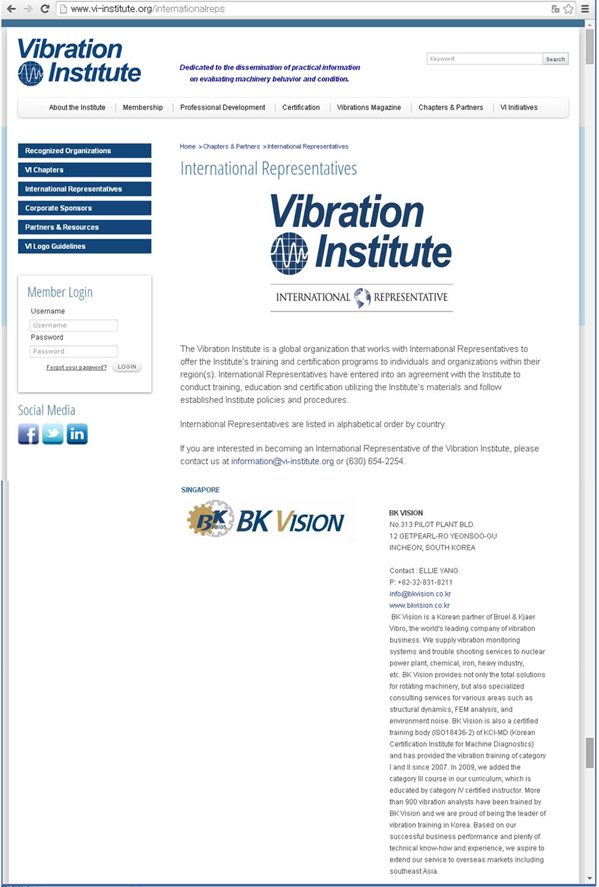
BK Vision 에서는 2014년부터 세계적으로 권위있는 미국의 Vibration Institute 로부터 국제 훈련기관 인증을 받고, ISO 자격과 더불어, 한국과 싱가포르에서 ANSI(미국 국가자격) 인증교육을 동시에 진행하고 있습니다.
2012년에 개정된 ISO17024 에 의거하여 ISO 자격은 해당 국가가 인정을 해주어야하므로, 한국설비진단인증원의 ISO자격은 한국인정지원센터로부터 인정을 받아 운영하고 있으며, 미국의 V.I.의 ISO자격은 ANSI 로 부터 자격을 인정받고 미국 국가자격으로 운영하고 있습니다.
과거와 같이 한국의 ISO 와 미국의 ISO는 더이상 상호 호환되지 않으므로, 해외 활동을 위해 국제 자격이 필요한 경우, 저희 BKVision 에서는 미국 국가자격인 ANSI 자격을 한국에서 교육을 받고 시험을 응시할 수 있도록 지원하고 있습니다.
Vibration Intitute 홈페이지에서 인증자 명단 확인하기
http://www.vi-institute.org/certifiedindividualsIntroduction
Vibration Institute Training Courses provide unique opportunities to study vibration principles in a way that goes beyond the textbook and provides real world applications. In addition to understanding theories and techniques our courses :
- - provide procedures to add to your practical knowledge of machines;
- - offer case studies to help analyze various types of equipment;
- - include demonstrations and workshops that illustrate methods to solve vibration problems;
- - have been developed using the body of knowledge compliant with ISO18436-2 Vibration Condition Monitoring and Diagnostics; and
- - follow ISO 18436-3 Requirements for Training Bodies and the Training Process which defines the requirements for bodies operating training programs in the non-intrusive machine condition monitoring, diagnostic and correction technologies.
교육과정 안내 스케쥴표. Vibration Analyst
CategoryISO 18436-2 Required
Experience for Exam EligibilityIMV BMV MVA AVA Category I ≥ 6 months O Category II ≥ 18 months O Category III ≥ 3 years O Category IV ≥ 5 years O
- ISO18436-2 : Condition monitoring and diagnostics of machines - Requirements for qualification and assessment of personnel, Part 2: Vibration condition monitoring and diagnostics
- IMV : Introduction to Machinery Vibration • BMV : Basic Machinery Vibration • MVA : Machinery Vibration Analysis
- AVA : Advanced Vibration Analysis
- In accordance with ISO 18436-3 the Vibration Institute offers a training examination on the course content on the final afternoon of the class. These examinations are designed to help assess
your knowledge and understanding of the training and course materials. - Each participant is given a score and a performance evaluation study guide on the training examination immediately after it is administered, in addition to a class review of the training exam. This information is intended to serve as an indicator of your technical strengths and areas for improvement. Please note that completion of the training exam in no ways qualifies the candidate for the Vibration Analyst Certification Exam. This is meant solely as a review of the materials covered during the training course. A combination of education, training and experience are recommended for a student to sit for a Certification Exam.
Training CoursesIntroduction to Machinery Vibration (IMV, Category I)Basic Machinery Vibration (BMV, Category II)교육과정 안내 스케쥴표. Monday -
• Vibration: Sources, Uses, Effects
- - Definitions, sources, effects, uses, predictive maintenance, measurement concepts, equipment.
- - Workshop I: Vibration Demonstrations and Workshop Questions
-
• Introduction to Machinery Vibrations I
- - Units, properties, measurement conventions, amplitude, frequencies, time, frequency
- - Workshop II: Definitions, Terminology, Measurements, Demonstrations
Tuesday -
• Introduction to Machinery Vibrations II
- - Measures, conversions, analysis, excitation, natural frequencies, resonance, and critical speeds.
- - Workshop III: Measure Analysis, Natural Frequencies, and Demonstrations
-
• Introduction to Data Collection
- - Sensors, frequency spans, measures, triggering, sensor mounting and location, instruments.
- - Workshop IV: Data Collection Demonstration and Workbook Questions.
Wednesday -
• Introduction to Machine Knowledge
- - Fault sources, frequencies, design and function of machines.
-
• Introduction to Vibration Testing
- - Periodic and permanent monitoring, machine analysis (fault and condition), acceptance testing.
- - Workshop V: Vibration Testing
-
• Introduction to Spectrum Analysis
- - Frequency identification and matching and procedures.
- - Workshop VI: Spectrum Analysis and Demonstrations
-
• Introduction to Common Machine Faults
- - Mass unbalance, misalignment, looseness, bearing defects, and electrical defects.
- - Workshop VII: Fault Analysis
Thursday -
• Introduction to Vibration Severity
- - Criteria, procedures, charts on housings, shafts, and bearings.
- - Workshop VIII: Vibration Severity
- • Course Review
-
• Training Examination on Course Content (One hour)
- - Training Examination Review
Friday - • Category I Exam
Machinery Vibration Analysis (MVA, Category III)Basic Machinery Vibration (BMV, Category II) Monday -
• Basic Machinery Vibrations I
- - Period, frequency, amplitude, phase, measures, conversions.
-
• Basic Machinery Vibrations II
- - Analysis, units, natural frequencies, forcing frequencies, resonance, critical speeds, damping.
Tuesday -
• Workshop I: Machinery Vibrations
- - Workshop II: Basic Vibrations
-
• Basic Data Collector Setup I
- - Measure selection; frequency spans; time, frequency, orbital displays.
-
• Transducers
- - Proximity probes, accelerometers, optical pickups, selection, location and mounting.
- - Workshop III: Data Acquisition
Wednesday -
• Basic Data Collector Setup II
- - Data sampling, triggering, window selection, resolution, dynamic range, averaging.
-
• Basic Analysis Techniques
- - Orders, spectrum analysis – direct frequency, side bands.
- - Workshop IV: Data Processing
-
• Evaluation of Machine Condition
- - Measures, procedures, severity charts, and alarm settings.
- - Workshop VI: Condition Evaluation
Thursday -
• Analysis of Operating Speed Faults
- - Orders, mass unbalance, misalignment, looseness, distortion, rubs, resonance, bearing wear
-
• Gear and Bearing Analysis
- - Measurement methods, frequencies, analysis techniques, and case histories.
-
• Motors, Fans, and Pumps
- - Basics, frequencies, techniques, and analysis.
- • Workshop V: Fault Analysis
Friday -
• Machine Testing
- - Test plans, impact testing, and acceptance testing.
-
• Periodic Monitoring
- - Screening, alarm setup, frequency of measurement, trending, and reports.
-
• Balancing
- - Fundamental aspects of single-plane balancing.
- - FWorkshop VII: Machine Analysis
- • Course Review
-
• Training Examination on Course Content (1.5 hours)
- - Training Examination Review
Sat - • Category II Exam
Machinery Vibration Analysis (MVA, Category III) Monday -
• Time and Frequency Analysis I
- - Display, use, and analysis of time domain, FFT analysis, modulation, clipping, pulsation, beats,
- - side bands, spectrum shape, synchronous and nonsynchronous signals, case histories.
-
• Phase and Orbit Analysis
- - Phase measurement and analysis, orbit evaluation, loop rules, orbit analysis, case histories.
- - Workshop I: Machinery Vibration Analysis Techniques
Tuesday -
• Resonance and Critical Speed Testing
- - Interference diagrams, analyzer setup for impact and transient tests, test procedures,
- - Bode/polar plot evaluation, case histories.
-
• Machine Condition Evaluation
- - Criteria, levels, maintenance actions, standards, evaluation of overall band, spectral, orbital,
- - time waveform, setting alarms, and examples.
Wednesday -
• Basic Vibration Control
- - Isolation, damping, resonance elimination, concepts, hardware, foundations, and pedestals.
- - Workshop III: Vibration Control and Correction
-
• Field Balancing Techniques
- - Single-plane, trial weight size and location, balance sensitivity, and phase lag.
- - Workshop II: Balancing Exercises
Thursday -
• Condition Monitoring
- - Objectives, program development, permanent and periodic monitoring, alternative techniques.
-
• Rolling Element Bearing Analysis
- - Analytic techniques, identification of defects on balls/cages/races, corrosion, fatigue,
- - excessive clearance, lack of lubrication, demodulation methods, condition evaluation.
-
• Operating Speed Diagnostics
- - Unbalance, sub-synchronous instability, coupling problems, misalignment, oil whirl/whip,
- - mechanical looseness, rubs, rotor bow, resonance, fluid-film bearings, condition evaluation.
-
• Pumps, Fans, Blowers, and Compressors
- - Pump impeller/casing/piping vibrations, natural frequencies, clearances, re-circulation, cavitation,
- - performance curves, impellers, casings, shafts, foundations, isolated bases, piping, ducting
- - Workshop IV: Machine Analysis
Friday -
• Motor and Generator Diagnostics
- - Mechanisms, vibration/current measurements, stator/rotor faults, shorted end rings,
- - broken rotor bars, air-gap variation, and variable-speed motors.
-
• Gears and Gearboxes
- - Measurement and analysis, gear mesh, cracked/broken/chipped teeth, gearbox evaluation.
- - Workshop V: Fault and Condition Exercises
- • Course Review
-
• Training Examination on Course Content (2 hours)
- - Training Examination Review
Sat - • Category III Exam
Training Courses ScheduleSINGAPOREKOREA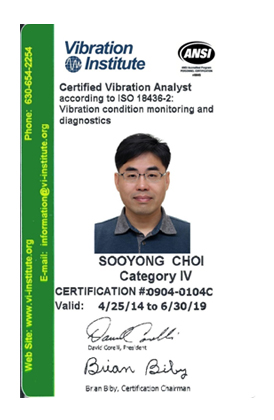
- Instructor : Sooyong Choi
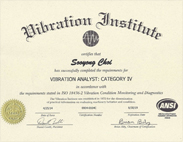
- ISO18436 Category 4 Vibration Analyst (Vibration Institute, 2009)
- ITC Thermographer Level 1 (ITC, 2012)
- ASNT Airborne Ultrasound Analyst Level 1 (UE Systems, 2012)
- Professional Engineer of Noise and Vibration
- Location : Spectris Pte Ltd.
- No.31 Kaki Bukit Road 3 #05-08 Techlink Singapore 417818
- Tel. : +65 9230 0295 E-mail: info@bkvision.co.kr
- BASIC MACHINERY VIBRATION ( Category II )
- ( In English Language )
- April 3 - 7, 2017
- June 19 - 23, 2017
- September 11 - 15, 2017
- December 4 - 8, 2017
- Instructor : Sooyong Choi
- ISO18436 Category 4 Vibration Analyst (Vibration Institute, 2009)
- ITC Thermographer Level 1 (ITC, 2012)
- ASNT Airborne Ultrasound Analyst Level 1 (UE Systems, 2012)
- Professional Engineer of Noise and Vibration
- Location : BK Vision Co.Ltd.
- M1401 32, Songdogwahak-ro, Yeonsu-gu, Incheon, Korea (21984)
- Tel. : +82 32 831 8211~2 E-mail: info@bkvision.co.kr
- BASIC MACHINERY VIBRATION ( Category II )
- ( In English Language )
- April 3 - 7, 2017
- June 19 - 23, 2017
- September 11 - 15, 2017
- December 4 - 8, 2017
 제품 사용자 무료 교육
- 교육 상세안내
-
제품 사용자 무료 교육 소개
B&K Vibro 제품 사용자 무료 교육은 기존 제품을 사용하고 계시는 고객뿐만 아니라, 저희 제품에 관심을 갖고 계시는 분들에 한하여 무료로 제품 사용자 교육을 진행을 하고 있습니다.
기존부터 제품을 사용하고 계시는 고객분들은 교육을 통해 제품 사용에 미숙한 부분이나 궁금한 부분을 해소하시고, 제품을 사용하고 계시지 않는 고객분들도 제품 구매 전 궁금하신 부분이나 성능을 미리 확인할 수 있는 계기가 되었으면 합니다.교육 내용
전반적인 장비 운용법부터 실무 적용 위주의 교육
교육 대상 장비
온라인 교육 - VC6000, VDAU, Compass
오프라인 교육 - VT60, VT80 & VP80
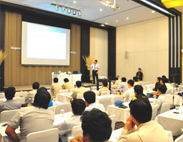
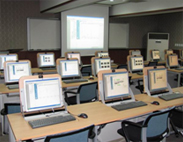
훈련기관 소개
 ISO 자격인증 훈련기관
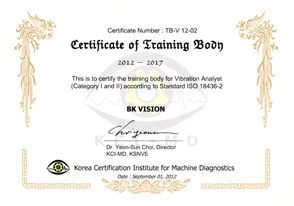
- 2007, ISO 18436-2 훈련기관인증(영역 1, 2)
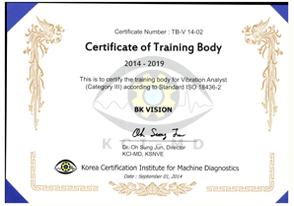
- 2009, ISO 18436-2 훈련기관인증(영역 3)
 ANSI 자격인증 훈련기관(미국 국가인증자격)
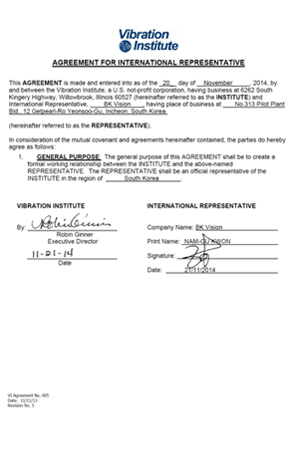
- 2014, ANSI 훈련기관인증(미국, Vibration Institute)
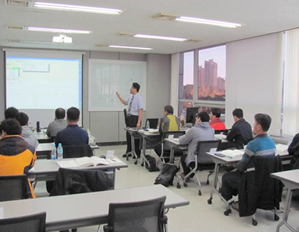
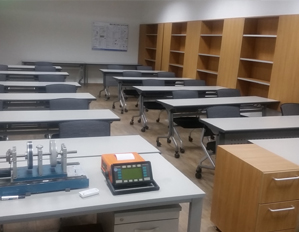


강사 소개
ISO 진동진단 영역4 인증 기술자
-
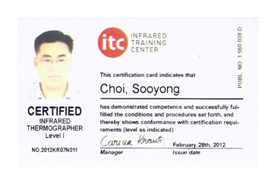
- ITC 열화상 진단 레벨1 인증 기술자
-
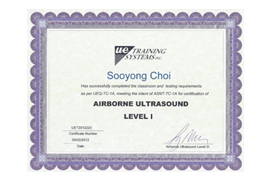
- ASNT 초음파 진단 레벨1 인증 기술자
Choi, SooYong
- - 소음진동기술사
- - ISO18436-2 Category IV 인증기술자
- - ASNT Airborne Ultrasound 레벨1 초음파 기술자
- - ITC Thermographer 레벨1 열화상 기술자
- - 6 시그마 Black Belt
- - 現)BK Visioin 교육&컨설팅사업부 이사
- - 삼성전자 DA연구소 책임연구원
- - 현대중공업 마북리연구소 주임연구원
- - 삼성전자 첨단기술연수소 소음진동 전문강사
- - 사단법인 한국소음진동기술사회 부회장
오시는 길
- 인천광역시 연수구 송도과학로 32 M동 1401호 (송도테크노파크 IT센터) 21984
- TEL. 032-831-8211~2
- FAX. 032-831-8218
- EMAIL. info@bkvision.co.kr